

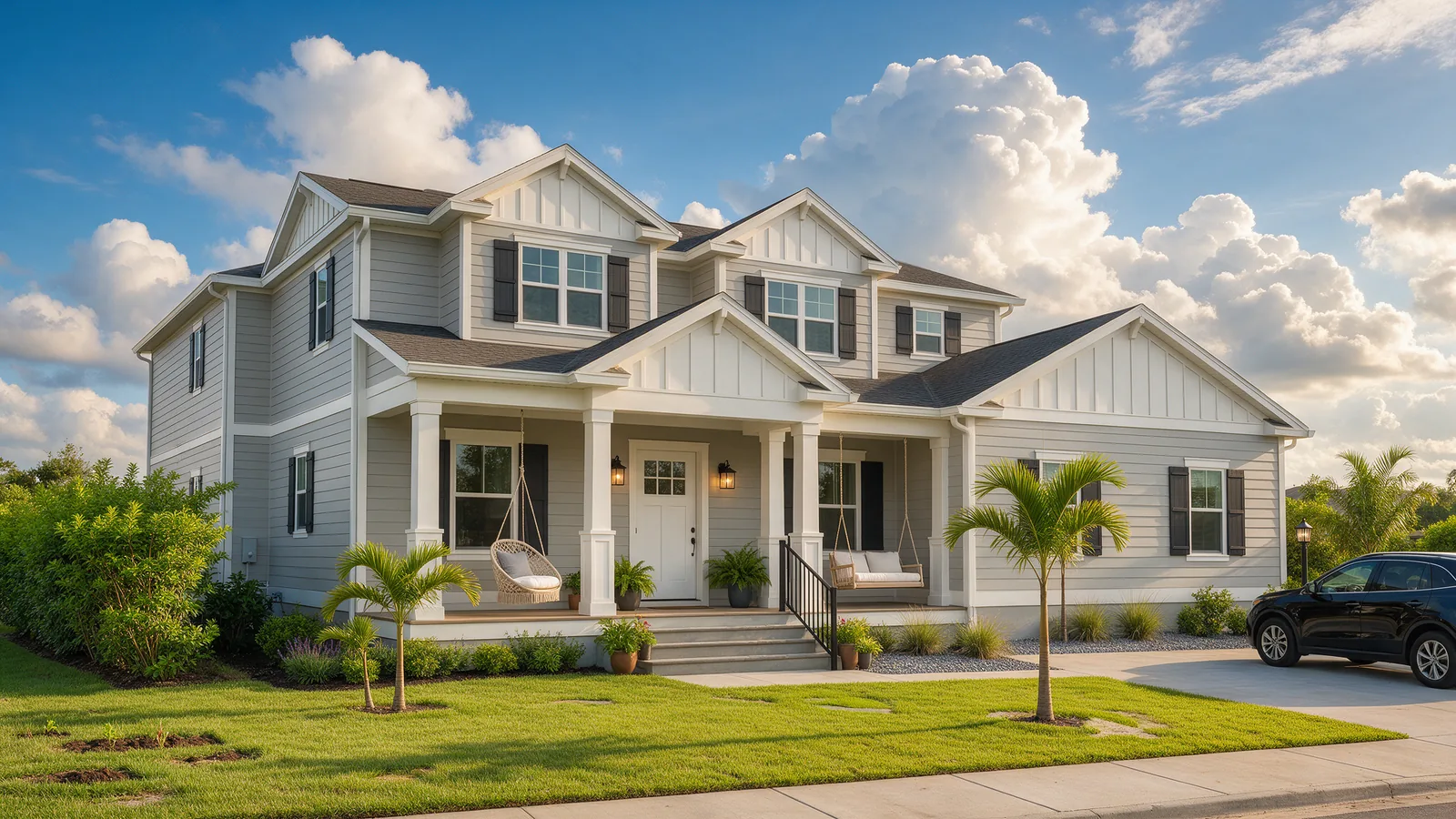
Every siding brochure is written for the whole country. Florida is not the whole country. Between the UV index, the afternoon storms, 90% humidity, salt in the air and a hurricane season that runs half the year, a material that performs beautifully in Ohio can look tired here in six years.
We install siding across Jacksonville, Orlando and Daytona, and we get asked the same question on almost every estimate: which material should I actually use? This is the honest answer, including where each option falls short.
What Florida does to an exterior
Before comparing products, it helps to know what they are up against. Four forces do most of the damage here:
- Moisture, constantly. Humidity plus daily summer rain means walls rarely dry out completely. Anything that absorbs water — untreated wood, unsealed cut edges — will eventually swell, cup or rot.
- UV. Florida sun fades pigment and makes cheap vinyl brittle years before its warranty runs out. Dark colors take the worst of it.
- Wind-driven rain. In a storm, rain does not fall, it travels sideways at 60 mph and finds every unsealed seam and every piece of missing flashing.
- Salt and pests. Near the coast, salt attacks fasteners and finishes. Inland, termites and carpenter ants are happy to eat traditional wood siding and the sheathing behind it.
Notice that three of those four are about water management, not about the siding itself. Hold on to that — it matters more than the brand you pick.
Fiber cement: the Florida default
Fiber cement is a mix of cement, sand and cellulose fiber, pressed into planks, panels and trim. It is what we install most often here, and the reason is simple: the things that destroy other siding in Florida barely register with it.
Why it works here
- It does not rot, and termites have no interest in it.
- It is dimensionally stable in humidity, so joints stay tight.
- It holds paint far longer than wood, because it does not swell and shrink with every rain.
- It is non-combustible, which insurers like.
- Manufacturers make substrates engineered for hot, humid climates — James Hardie calls its version HZ10, and it is the right spec for our region.
The trade-offs
- It is heavy, so installation is slower and more labor-intensive than vinyl. That shows up in the estimate.
- It is painted, so expect to repaint every 10 to 15 years. Factory-finished products push that out further.
- Cutting it makes silica dust, which is a real health issue — a crew that dry-cuts it with no dust control is a crew to avoid.
We work with James Hardie, Nichiha and Allura. You can see how these look on finished houses on our project gallery, and the installation details on our siding installation page.
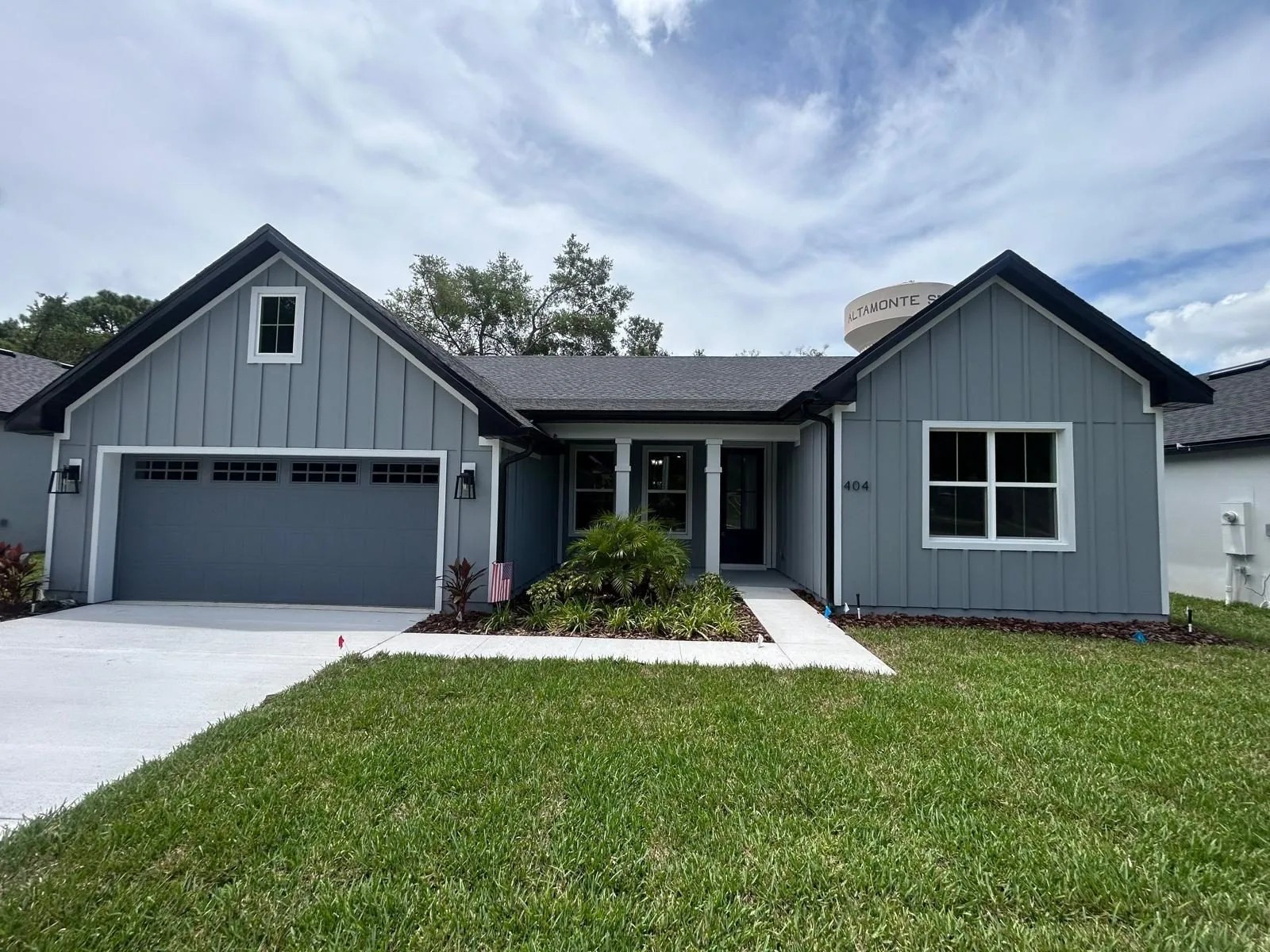
Vinyl: the budget that can still work
Vinyl gets dismissed too quickly. It is the least expensive option per square foot, it never needs painting, and modern panels look far better than what was on the market 20 years ago. On a rental, a flip or a tight budget, it is a legitimate choice.
Where it struggles in Florida
- UV fade. Dark colors lose saturation fast. Lighter colors age much better here.
- Heat distortion. Panels expand and contract a lot. If they are nailed too tight, they buckle — a common sight on houses where the crew rushed.
- Impact. A branch in a storm cracks vinyl where fiber cement would only chip paint. Cold makes it brittle, which matters less here, but age plus UV does the same thing.
- It hides problems. Vinyl is often installed over old siding, which is where trapped moisture starts.
If vinyl is the right call for your budget, spend the savings on thickness and on a proper tear-off rather than on a fancy color.
Engineered wood: the middle ground
Engineered wood siding — the category most people know through LP SmartSide — is wood strands bonded with resins and treated against moisture, fungal decay and termites. It arrives primed and is installed like a thick, light plank.
- Lighter than fiber cement, so labor is a bit lower and there is less stress on older framing.
- Deep, crisp shadow lines. If you want the look of real wood lap siding without real wood's maintenance, this is the closest.
- Long warranties, and it handles impact better than both fiber cement and vinyl.
The catch is that it is still a wood-based product. Every cut edge has to be sealed, the clearance to grade has to be respected, and sprinklers that hit the wall twice a day will shorten its life. Installed properly, it performs well here. Installed carelessly, it is the first material to show problems.
What about stucco?
A large share of Florida homes are stucco, and it is not a bad system — it is just a different one. Stucco cracks as a house settles, and in our climate those hairline cracks are a path for water. Repairs are ongoing rather than occasional.
Plenty of our customers move from stucco to fiber cement or a mix of lap siding and board-and-batten, both for the look and to stop chasing cracks. If you like the masonry look but want less maintenance, mortarless stone veneer such as Evolve Stone is another route, often as an accent on the front elevation.
Side-by-side comparison
| Fiber cement | Vinyl | Engineered wood | |
|---|---|---|---|
| Typical lifespan here | 30+ years | 20–30 years | 25–30+ years |
| Rot & termites | Immune | Immune | Treated, but wood-based |
| UV / fading | Excellent, repaint as needed | Weakest point | Very good |
| Impact resistance | Good | Weak | Best of the three |
| Maintenance | Wash; repaint 10–15 yrs | Wash only | Wash; repaint 10–15 yrs |
| Weight / labor | Heavy, slower install | Light, fastest install | Medium |
| Installed cost | $$$ | $ | $$ |
What it costs installed in Florida
These are planning ranges for 2026, not a quote. They cover material and labor per square foot of wall, assuming a standard tear-off and replacement:
- Vinyl: roughly $5–$9 per sq ft installed
- Engineered wood: roughly $8–$13 per sq ft installed
- Fiber cement: roughly $10–$16 per sq ft installed
What moves a project inside — or above — those ranges:
- What we find behind the old siding. Rotten sheathing and framing repairs are the single biggest variable, and nobody can see them from the driveway.
- Stories and access. Two-story walls, steep grades and tight side yards all add staging time.
- Trim and detail work. Corners, windows, gables and mixed textures take hours that flat walls do not.
- Soffit, fascia and gutters. Often replaced at the same time, because doing it later means touching the same areas twice. More on that on our soffit & fascia page.
- Paint. Factory finish costs more up front; field painting gives you exact color control.
A note on "cheap" estimates
When one bid comes in far under the others, it usually means one of three things: no tear-off, no allowance for repairs, or no permit. All three cost more later. Ask every contractor what happens, in writing, when they find rot.
If the timing matters more than the cash flow, we offer GreenSky® financing so the project does not have to wait for a rainy day fund.
What we would put on your house
- Coastal, within a few miles of salt air: fiber cement with stainless or hot-dipped galvanized fasteners. Salt eats cheaper fasteners, and a perfect plank on a corroded nail still fails.
- Inland family home, staying 10+ years: fiber cement, usually lap siding with board-and-batten accents on gables.
- Want the wood look, softer budget: engineered wood, with every cut edge sealed.
- Rental or short hold: quality vinyl, light color, full tear-off.
- HOA community: whatever the board approves — bring them a sample board and the manufacturer's color name, not a photo. We do this with customers all the time.
The details that decide everything
Here is the part the brochures skip: the installation matters more than the material. We have torn off premium siding that failed in eight years, and we have replaced builder-grade panels that were fine at twenty. The difference is always in these details.
- The water-resistive barrier. House wrap has to be lapped like shingles, top layer over bottom, so gravity sends water out and not in.
- Flashing. Head flashing over every window and door, kickout flashing where a roof meets a wall. Missing kickout flashing is the most common cause of hidden rot we find.
- Clearance. Manufacturers ask for roughly 6 inches between siding and grade, and 1 to 2 inches above roofing. Siding buried in mulch wicks water forever.
- Fasteners. Correct type, length and spacing for the wind zone — and corrosion-resistant near the coast.
- Sealed cut edges on fiber cement and engineered wood. Every plank cut on site exposes raw material.
- Permits and inspections. A permitted job creates a record for insurance and for the next buyer.
Ask any contractor you are considering how they handle kickout flashing and clearance to grade. The answer tells you what you need to know in about ten seconds.
Frequently asked questions
What is the best siding for Florida weather?
For most homes, fiber cement: it does not rot, termites ignore it, and it holds paint through high UV. Vinyl works inland on a tighter budget, and engineered wood is the middle ground with the crispest wood look.
How much does siding cost in Florida?
As a planning range for 2026: vinyl about $5–$9 per square foot installed, engineered wood about $8–$13, fiber cement about $10–$16. Tear-off, repairs, height and trim detail decide where you land.
Does siding help with hurricanes?
Siding is a weather barrier, not a structural system. What protects the house is the whole assembly: a properly lapped barrier, the right fasteners at the right spacing, and flashing at every opening.
How long does siding last in Florida?
Fiber cement commonly passes 30 years with repainting every 10 to 15. Engineered wood is similar when cut edges are sealed. Vinyl runs 20 to 30 years inland, less if dark colors face full afternoon sun.
Can I put new siding over the old siding?
Sometimes, but we rarely recommend it. Covering the old layer hides rot, trapped moisture and failed flashing — the very problems that shorten the life of the new siding.
Not sure which one fits your house?
We will walk your exterior, tell you what we would install and why, and put it in writing at no cost. Request a free estimate or call (407) 436-4020.