

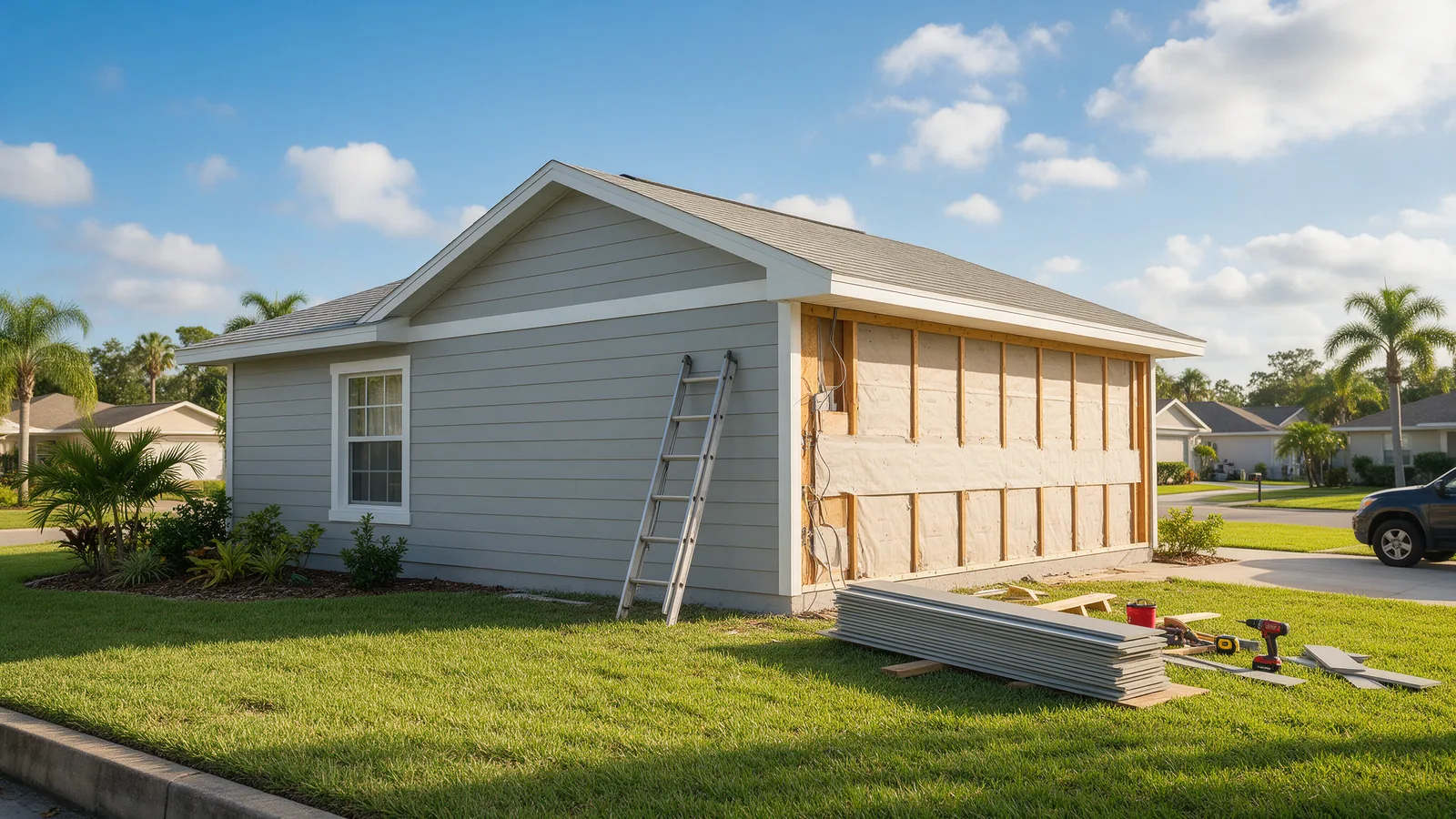
"What does siding cost?" is the first question on almost every call we get, and the honest answer — "it depends" — is useless to someone trying to plan. So here are the actual ranges we see in Florida, what sits behind them, and how to read a quote so two bids can be compared fairly.
The short answer
For a full tear-off and replacement on a typical Florida single-story home, plan on:
- Vinyl: about $9,000 – $18,000
- Engineered wood: about $14,000 – $26,000
- Fiber cement: about $18,000 – $32,000
Two-story homes usually land 40% to 70% above the equivalent single-story number, because there is more wall and because everything above ten feet takes staging, time and a second person.
These are planning ranges, not a quote
They exist so you can tell whether a project is a $12,000 conversation or a $30,000 one before anyone walks your property. The accurate number comes from measuring your walls and seeing what is behind the old siding.
Cost per square foot by material
Siding is priced by square foot of wall area — not the living area of the house. Installed, including tear-off and standard trim:
| Material | Installed / sq ft | Repaint cycle | Best fit |
|---|---|---|---|
| Vinyl | $5 – $9 | Never | Rentals, tight budgets, inland |
| Engineered wood | $8 – $13 | 10–15 years | Wood look, impact resistance |
| Fiber cement | $10 – $16 | 10–15 years | Long hold, coastal, HOA communities |
| Mixed (lap + board & batten) | $12 – $18 | 10–15 years | Front elevation character |
If you want the durability reasoning behind each material rather than the price, we broke that down in best siding for Florida homes.
How to measure your own house
You can get within about 10% in fifteen minutes with a tape measure:
- Walk the perimeter and add up the length of every exterior wall.
- Multiply by wall height — roughly 10 feet per story.
- Add the gables. For each triangular gable end, take half the width times the height.
- Do not subtract windows and doors. Openings cost more in labor and trim than the siding they displace, so the industry prices them as if they were solid wall.
A 1,800 sq ft single-story home with a simple roofline usually works out to 1,600–2,000 sq ft of wall. Multiply that by the per-square-foot range above and you have your own ballpark before anyone knocks on your door.
The eight things that move the price
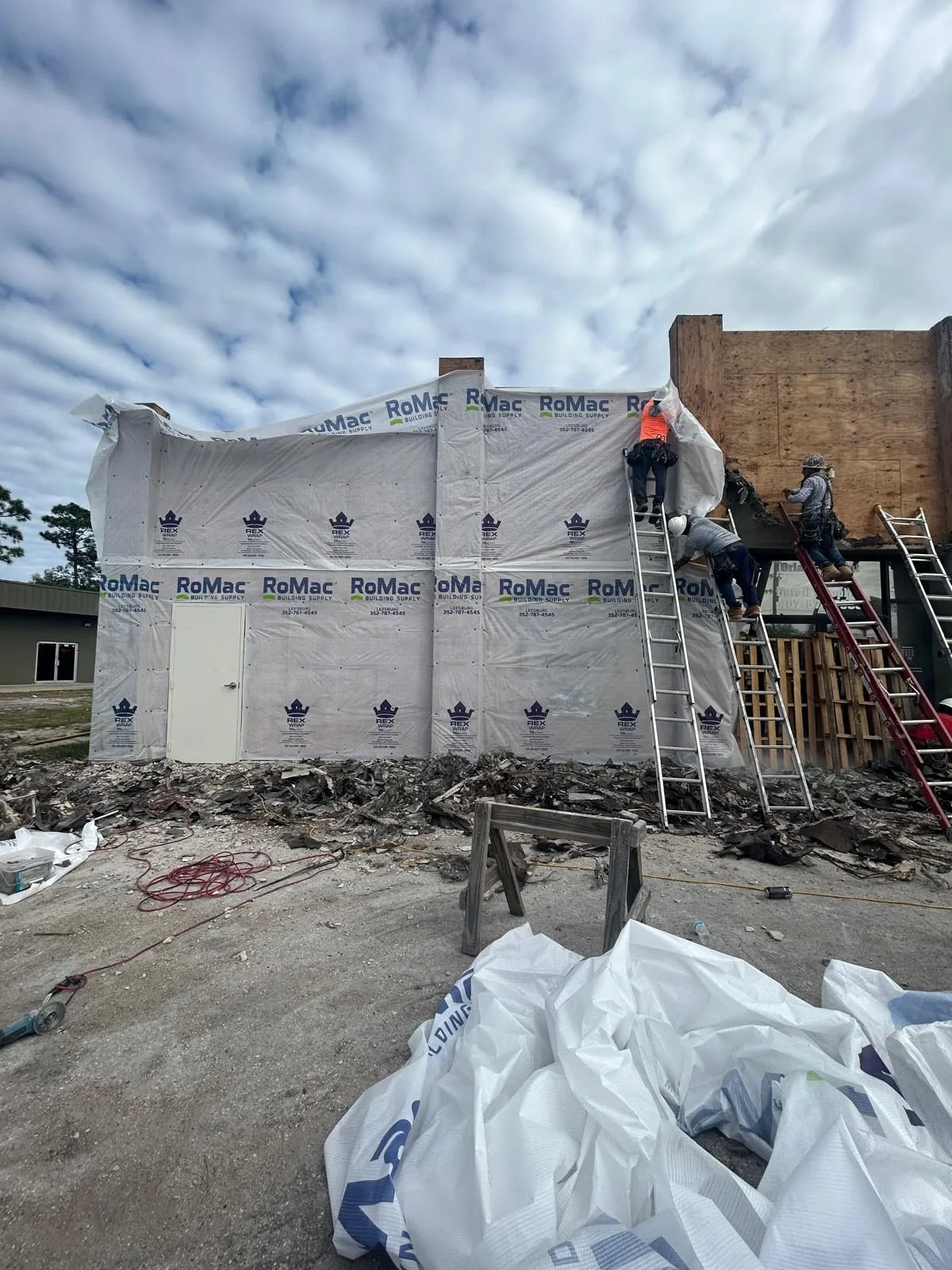
- Tear-off versus overlay. Removing and disposing of the old siding adds labor and a dumpster, and it is the only way to see the wall.
- Rotten sheathing and framing. The single biggest unknown. On Florida homes 20+ years old with original siding, finding some rot is normal, not a surprise.
- Stories and access. Two-story walls, steep lots, tight side yards, pools and screen enclosures all slow a crew down.
- Trim and detail. Corner boards, window and door casing, frieze boards, gable vents, mixed textures — each one is cuts, flashing and caulk.
- Number of openings. A wall with nine windows costs more than a blank wall of the same size.
- Material grade and finish. Factory-finished planks cost more than primed planks you paint on site, and buy you a longer finish warranty.
- What goes with it. Soffit, fascia and gutters are usually replaced in the same pass, because reaching those areas twice costs more than doing them once.
- Permits, inspections and disposal. Permit fees vary by county, and debris removal is a real line item on a full tear-off.
Three realistic examples
Illustrative, using the ranges above — your house will have its own quirks.
- 1,500 sq ft single-story ranch, vinyl, simple roofline. About 1,500 sq ft of wall. Expect the low-to-mid teens in vinyl, and roughly double that in fiber cement with new trim.
- 2,400 sq ft two-story, fiber cement lap with board-and-batten gables. Around 2,800–3,200 sq ft of wall once the gables are counted, plus staging. This is the project most often financed.
- 1,200 sq ft rental, vinyl, no trim changes. The cheapest realistic full replacement — and still worth a tear-off, because a rental with rot is a rental with a claim.
Repair or replace?
Not every problem needs a whole house. Replacing a few planks is the right call when the damage is isolated — one impact crack, a soft spot under a leaking gutter, a section a tree branch caught. If your siding is otherwise sound and the color is still available, a repair costs a few hundred dollars instead of five figures.
Replacement becomes the better buy when the symptoms show up in more than one place at once:
- Rot or softness in several spots, especially low on the wall or under windows. That is a water-management problem, not a plank problem.
- Paint that fails again within two or three years. On wood-based siding that is usually moisture coming from behind, not bad paint.
- Panels that move, buckle or rattle in wind — a fastening pattern that was wrong from the start.
- A discontinued profile or color. Patchwork that does not match costs you on resale.
- You are repainting anyway. On a house that needs a full repaint plus repairs, the gap to new siding is smaller than people expect.
A useful rule: when repairs reach about a quarter of what replacement would cost, replacing is usually the cheaper decision over ten years.
How long it takes, and what it is like to live through
Most single-story homes run four to eight working days; two-story and mixed-material projects run two to three weeks. Rain days and rot repairs are what stretch a schedule, and in Florida summer you plan around the afternoon storms rather than pretending they will not come.
- Permit and material order — typically a week or two before anyone shows up, depending on the county and the product lead time.
- Tear-off, one elevation at a time. We do not open more wall than we can close before the day ends.
- Repairs and barrier. Sheathing fixed, wrap lapped, flashing set.
- Install and trim, then caulk and paint if the finish is done on site.
- Inspection and walkthrough. We walk it with you and fix the punch list before the final payment.
Things worth knowing: you keep living there the whole time, interior walls are never opened, and you will want to move the cars and anything fragile hanging on the walls. Pets and the crew both do better if the yard gates stay closed.
How to read an estimate
A complete estimate names the things that cost money. Ours — and any good one — should show:
- The product by name: manufacturer, product line, profile, exposure and finish.
- Tear-off and disposal, stated explicitly.
- Water-resistive barrier and flashing, including kickout flashing at roof-wall intersections.
- Trim package: corners, casing, soffit and fascia if included.
- An allowance for rot repair, with a stated unit price for sheathing and framing beyond the allowance.
- Permit, who pulls it, and who meets the inspector.
- Payment schedule and the warranty on labor, separate from the manufacturer's material warranty.
The three red flags
A bid far below the others almost always skips tear-off, skips the rot allowance, or skips the permit. Any contractor who will not put the rot-repair unit price in writing is telling you how the conversation will go in week two. And a large deposit before material is ordered is not how this trade works.
Where you can save, and where you should not
Legitimate ways to bring the number down:
- Phase it. Front elevation in premium material this year, the rest next year. Common in HOA neighborhoods where only the front is governed.
- Simplify the trim. Standard corners instead of oversized boards saves real labor without hurting durability.
- Field paint instead of factory finish, if you want exact color control and can accept a shorter finish warranty.
- Finance it rather than downgrading the material. Our GreenSky® plans exist for exactly this trade-off.
Where saving costs you more later: skipping the tear-off, skipping flashing details, cheap fasteners near the coast, and no permit. Every one of those turns into a repair that costs more than it saved.
Does it pay you back?
Siding replacement consistently ranks among the exterior projects with the strongest return in national remodeling surveys, for a simple reason: it changes the entire first impression of a house rather than one room of it.
In Florida there is a second effect. A sound exterior removes an item that inspectors flag and insurers ask about, and a house that photographs well sells faster. Our project gallery has before-and-after examples of what that change looks like.
Frequently asked questions
How much does it cost to replace siding on a house in Florida?
For 2026, plan on roughly $9,000–$18,000 in vinyl, $14,000–$26,000 in engineered wood and $18,000–$32,000 in fiber cement for a typical single-story home. Wall area and hidden rot decide where you land.
How do I measure how much siding I need?
Perimeter × wall height (about 10 feet per story), plus half the width × height for each gable. Do not subtract windows and doors — openings add labor, not savings.
Why are siding quotes so different from each other?
Because they rarely cover the same scope. Check tear-off, rot allowance, flashing, trim, soffit and fascia, permit and disposal before you compare totals.
Is it cheaper to put new siding over the old siding?
Cheaper that week, more expensive over the life of the wall. It hides rot, traps moisture and makes proper flashing nearly impossible.
Does new siding increase home value?
It is one of the better-returning exterior projects, and in Florida it also clears an item that inspectors and insurers look at.
Want the real number for your house?
We measure the walls, look at what we can see of the existing assembly and put the scope in writing — including what happens if we find rot. No cost, no pressure. Request a free estimate or call (407) 436-4020.