

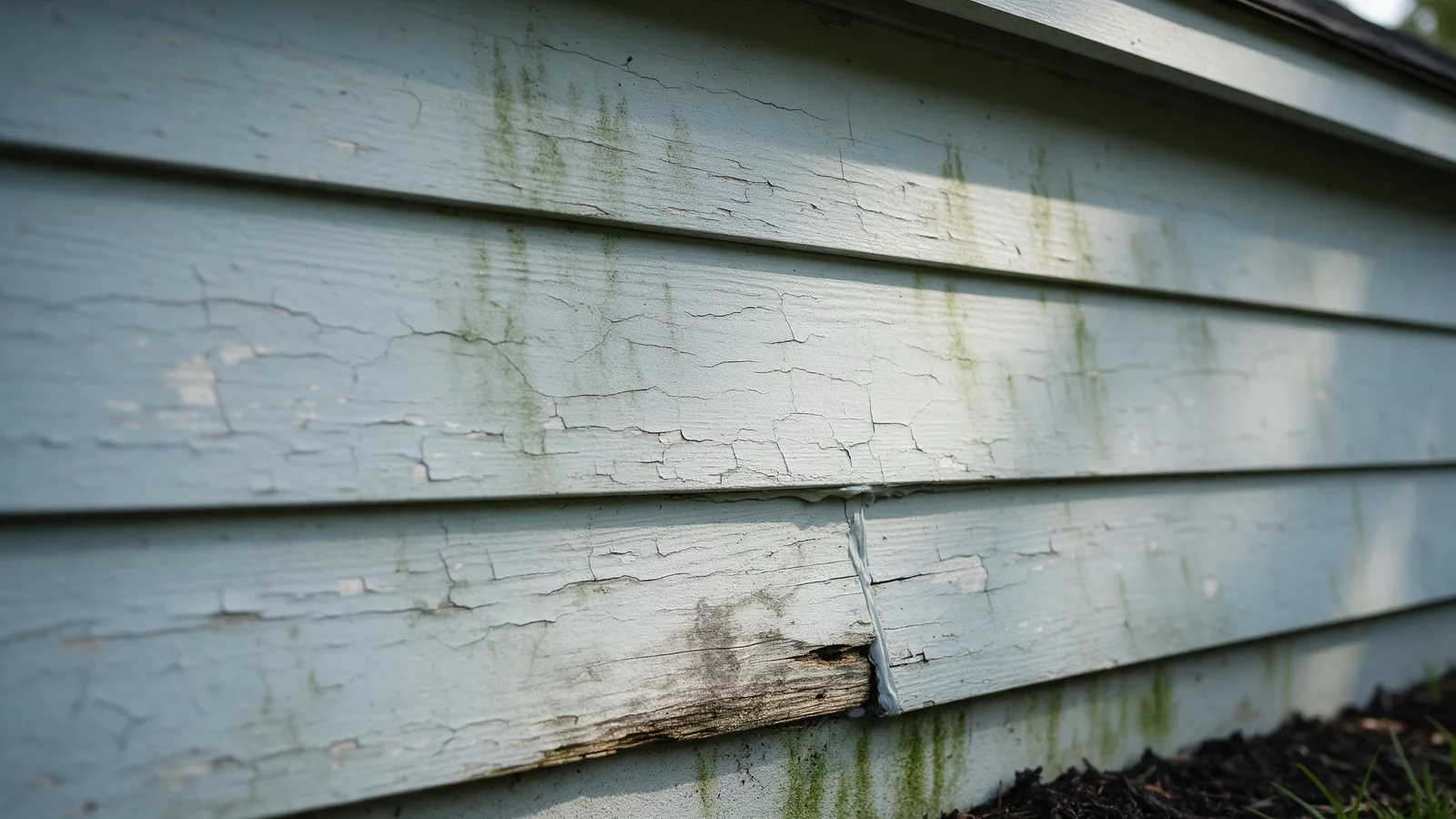
Almost every failed wall we tear off had been telling the owner for two or three years. Not dramatically — a little soft spot by the hose bib, paint peeling on the same gable every time, a joint that opened and never closed again. By the time it reaches the inside of the house, the repair has roughly tripled.
So here is the walk we do on every estimate, in the order we do it, with what each sign actually means. Do it after a few days of rain, which is when a wall shows its weaknesses.
1. Soft spots
Press the handle of a screwdriver against the siding, firmly, every few feet along the lower third of each wall. Sound material pushes back. Soft material gives, and gives quietly.
Pay attention to the usual suspects: under windows, beside hose bibs, behind downspouts, at the bottom course near mulch beds, and anywhere a sprinkler hits the wall twice a day. Softness means the plank has absorbed water, and water that reached the plank almost always reached the sheathing behind it.
One soft spot or many?
One isolated soft area near an obvious source — a leaking gutter, a broken sprinkler head — is usually a repair. The same softness showing up on three elevations is a water-management problem, and patching planks will not fix it.
2. Paint that keeps failing
Exterior paint on a sound Florida wall should give you a decade. If you repainted three years ago and it is peeling, blistering or flaking again — especially in the same spots — the moisture is coming from behind the paint, not from the weather hitting it.
This is the sign homeowners most often misread. They assume the painter used cheap product and hire another painter. Two years later it fails again, and they have paid for the wall twice without fixing it. If your repaint is not holding, have the substrate looked at before you buy more paint.
3. Swollen, bubbling or delaminating planks
Wood-based and hardboard siding swells along the bottom edge first; the plank looks thicker there, the edge rounds over, and eventually the layers separate like a wet book. On older hardboard you will sometimes see the surface bubbling in the sun.
Once a plank delaminates, nothing brings it back. Caulk and paint over it buys a season at most.
4. Open joints and caulk pulling away
Look at the butt joints between planks, and at the lines where siding meets corner boards, window casing and door trim. You are looking for daylight, hairline gaps, and caulk that has shrunk, cracked or pulled away from one side.
Those joints are where wind-driven rain enters. In a Florida storm, rain does not fall — it travels sideways, and a gap the width of a credit card is all it needs. Caulk is maintenance; it is supposed to be renewed. But if every joint on a wall has opened at once, the planks are moving, which means the fastening or the material is at the end of its life.
5. Warped, buckled or cracked panels
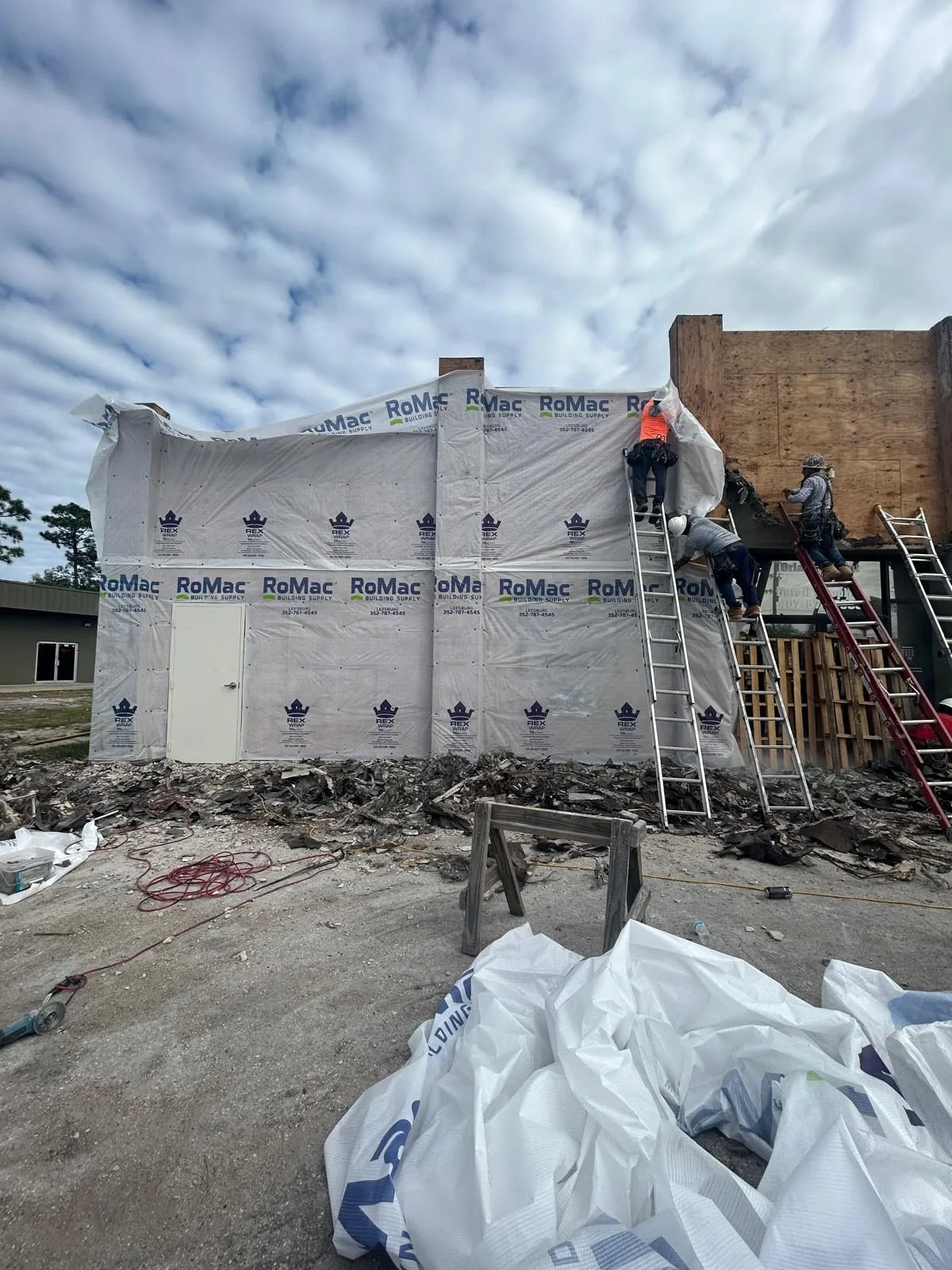
On vinyl, waviness along a wall usually means the panels were nailed too tight: they need room to expand in the heat, and when they cannot, they buckle. Cracks appear after years of UV make the material brittle, or after a branch finds it in a storm.
On fiber cement, cracking is rarer and usually local — an impact, or a plank fastened into nothing. Either way, a cracked plank is an open door for water, and on a two-story wall it is not a weekend fix.
6. Streaks and mildew that come back within weeks
Everything grows here, and some algae on a north-facing wall is normal — that is what a wash is for. What is not normal is dark streaking that returns a few weeks after cleaning, or a stain that follows the same vertical line down the wall every time.
A repeating pattern means water is being delivered to that spot: a clogged gutter, a missing kickout at a roof-wall intersection, a window that is not flashed at the head. Clean it and watch it. If the pattern comes back in the same shape, it is plumbing you with water, not dirt.
7. Signs showing up inside the house
Walk the inside of the exterior walls, especially below windows and in corners:
- Baseboards separating from the wall or feeling soft.
- Paint or wallpaper bubbling in a line below a window.
- A faint musty smell in a closet on an exterior wall.
- Drywall nail pops and stains that reappear after you paint over them.
These mean the water has already crossed the wall assembly. At that point the question is no longer whether the siding needs work — it is how much framing goes with it.
8. Wasps, ants and woodpeckers
Carpenter ants and termites want wood that is already damp; a trail of ants along the bottom course in the evening is worth following. Wasps nest in gaps behind loose planks and in open soffit seams. Woodpeckers are the blunt version of this test: they are after insects, and they drill where the wood is soft.
Pests do not cause the failure. They find it before you do, which makes them useful.
9. Missing flashing and buried siding
Two details decide more Florida wall failures than anything else, and both are visible from the yard:
- Kickout flashing. Where a roof edge dies into a wall, there should be a small piece of metal that kicks runoff out into the gutter instead of letting it run behind the siding. Stand at that corner and look up. If there is nothing there, water has been going into the wall every time it rains.
- Clearance to grade. Siding should sit roughly six inches above soil and two inches above roofing. Siding buried in mulch, soil or a raised flower bed wicks water continuously, and the damage is always worse than it looks.
While you are looking up, check the soffit and fascia: stained, sagging or vented-but-rotten soffit panels usually mean the gutter or roof edge has been feeding water into that area for years.
What to do with what you found
| What you saw | What it usually means | How fast |
|---|---|---|
| Algae on a shaded wall | Normal in Florida | Wash it |
| One cracked plank | Impact damage | Repair, this season |
| Caulk cracked at trim | Routine maintenance | Before hurricane season |
| Soft spot in one area | Local water source | Have it looked at |
| Paint failing again in 2–3 yrs | Moisture behind the wall | Have it looked at |
| Soft spots on several walls | Assembly is failing | Replacement conversation |
| No kickout flashing | Water entering at roof-wall | This month |
| Stains inside the house | Water crossed the wall | This week |
Why Florida timing matters
Two seasons shape this decision. Hurricane season turns a small opening into a large one, because wind-driven rain enters gaps that normal rain never finds — so anything on the "this month" line is worth doing before the season, not after. And our humidity means a wet wall never really dries, so damage here compounds faster than the same damage would in a drier state.
The practical version: a wall that was going to need work in three years tends to need it in one if it goes through a bad storm wet.
Repair, or replace?
Replacing a few planks is the right call when the damage is isolated and the rest of the wall is sound. Replacement wins when the same symptom shows up in several places, when the profile or color is discontinued, or when you are about to repaint a house that also needs repairs — the gap between those two numbers is smaller than people expect.
We put real ranges on both paths in what siding replacement costs in Florida, and if you are already weighing materials, best siding for Florida homes covers how each one holds up here.
Frequently asked questions
How do I know if my siding needs to be replaced?
One problem in one place is a repair. The same problem — soft spots, failing paint, open joints — in several places means water is getting behind the siding, and patching planks will not fix the assembly.
How long does siding last in Florida?
Fiber cement commonly passes 30 years with repainting every 10 to 15; engineered wood is similar when cut edges are sealed; vinyl runs 20 to 30 inland. Installation quality matters more than the warranty number.
Is soft siding always rot?
Softness means the material absorbed water, which is the first stage. It also means the sheathing behind it is probably wet, which is the part that costs money.
Can I just paint over damaged siding?
Paint is a finish, not a repair. Over a wet wall it fails in a season or two and you pay twice.
What does a siding inspection cost?
Ours is free. We walk the elevations, check trim, flashing and clearance to grade, and tell you honestly whether you are looking at a repair or a replacement.
Found two or three of these on your walk?
Send us photos, or let us come look. We will tell you whether it can wait, what it would take to fix, and what it would cost — in writing, at no charge. Request a free estimate or call (407) 436-4020.